Fashion Speaks, The Language of What We Wear
In the world we live in, we constantly hear it’s what’s on the inside that counts. Yet, at the same time, we are told by our mothers, teachers and even self-help books that in terms of reaching your goals, first impressions matter. But when these conflicting messages are coming at us from all sides, how are we ever supposed to grasp which path to follow?
The award shows we watch, such as the Golden Globes, MTV Music Awards and the Oscars, celebrate the esteemed actors and accomplished directors are preceded by hours-long talk-shows which dissect down to the very thread each article of clothing the celebrities wear in front of the cameras.
Political debates are swarmed by photographers who hope to snap the winning photo that will end up on the front of a tabloid; not of the person running for a spot at the supreme court bench, or an office in the capitol building, or even an oval office in the white house–but rather a photo of the clothes on their backs. Female politicians are often the target of even greater scrutiny, with headlines sometimes focusing more on their wardrobes than their words.
There’s no denying that celebrities and those in the media are heavily scrutinized for the way they look and dress. This is nothing new–in fact, it’s been a common occurrence since before people acknowledged the standards of beauty. TIME Magazine even published an article titled “Our Brains Immediately Judge People” which describes how even a split-second viewing of a persons’ face can leave one with a sense of trustworthiness—if said face has certain characteristics. For example, high-set eyebrows and prominent cheekbones are thought to be characteristics of people deemed trustworthy.
So how does this play into the celebrities we root for or the political candidates we endorse? Are our brains hardwired to look for the candidate with the highest cheekbones? Science says possibly.
But if that’s true, if our brains are working against us in terms of being capable of looking past the bone structure and hairline to see what’s on the inside, our society today has found a way to instead work with these presuppositions to change the way people act and aid in what they believe in.
Dr. Ron Becker, an area coordinator for Miami University’s media and culture program, believes the psychology behind how we judge others’ appearances can be tied back to the media and how it not only connects with the ideals we hold about outward appearances, but the way society comes to accept and promote self-expression through what we wear.
“If you look at the 1970s and the second-wave feminist movement, people wanted to capitalize on that (female empowerment and its increasing presence in the media),” Becker said. He went on to talk about how the second-wave feminist movement and political ideologies that encompassed the 1970s were aided and even further propagated by the media’s coverage of it. He explains that society was going through a major shift, and if companies, especially television and fashion companies showed their support through advertisements, it would drive consumers to choose those brands that conformed to their own beliefs and values.
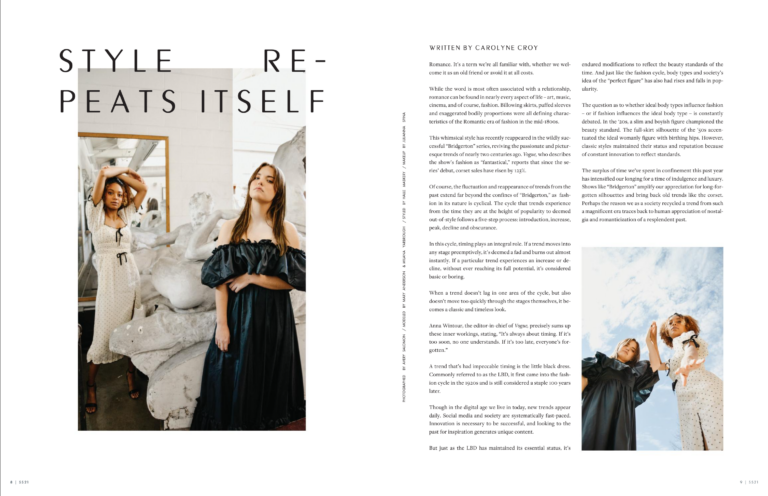
Evidence of this idea that the media propagates what people consider in good taste, or in style can be seen throughout years in the past. Coco Chanel, for example, could possibly be credited with the desire many people have to have bronzed skin. According to a Wonderland Magazine article titled “Seven Wonders: How Coco Chanel Changed the Course of Women’s Fashion,” in 1923, she accidentally got sunburned while on vacation in the French Riviera. Her peers celebrated her sun-kissed glow and it ultimately became a symbol of wealth and beauty that has lasted until today as sunless-tanning products are in their prime.
But even though Chanel’s statement was praised and made a lasting impact on the fashion and beauty industry for decades to come, women’s beauty and fashion choices don’t always receive the same celebration today.
Today, we can’t look on social media, watch television, or glance at the magazines while in line at the grocery store without seeing an article titled something like who wore it best? or this week’s fashion mishaps. Has the mainstream media shifted its focus from propagating the latest trends in fashion and beauty to the trend of shaming others?
Former first lady Michelle Obama wrote about the media’s scrutiny in her memoir, Becoming. “It seemed that my clothes mattered more to people than anything I had to say,” she said. “Optics governed more or less everything in the political world, and I factored this into every outfit.”
As first lady, political standards lead a whole new slew of expectations and rules of what a woman should look like into the mix. As it often does in politics, in Obama’s case, things got messy and criticism was splashed on the page of every newspaper and magazine across America. Obama’s stylist, Meredith Koop described how she had a strategy of dressing the first lady as she was well aware of the attention every article of clothing would receive, “You have to anticipate every avenue of attack and every possible outcome.”
And it’s not only Koop, first lady Obama or Chanel who know that sometimes what they wear can have more of an impact than what they say. The 2018 Golden Globes will be remembered more for the outfits than the awards that were given. According to TIME Magazine’s 2018 Golden Globes recap, over 300 leading women in the Hollywood movie industry used the event to promote the “Time’s Up” movement. They stole the attention of photographers, TV show hosts, internet screens and newspaper front pages as dozens showed up in all-black outfits and sporting Time’s Up pins on their extravagant dresses and sleek suits.
While the media’s scrutiny of women and their appearances are far from over, perhaps we should all take some advice from former first lady Obama’s stylist when we get dressed in the morning. “You have to celebrate fashion but also be aware of the message people are going to take away. Fashion can bolster communications in the best-case scenario, or be a silent partner, or actually distract,” Koop said.
It’s obvious the clothes we wear have a greater message than we ever knew. However, as we become more fluent in the language of fashion, perhaps we can change the narrative and drive the difference we are so desperate to experience.