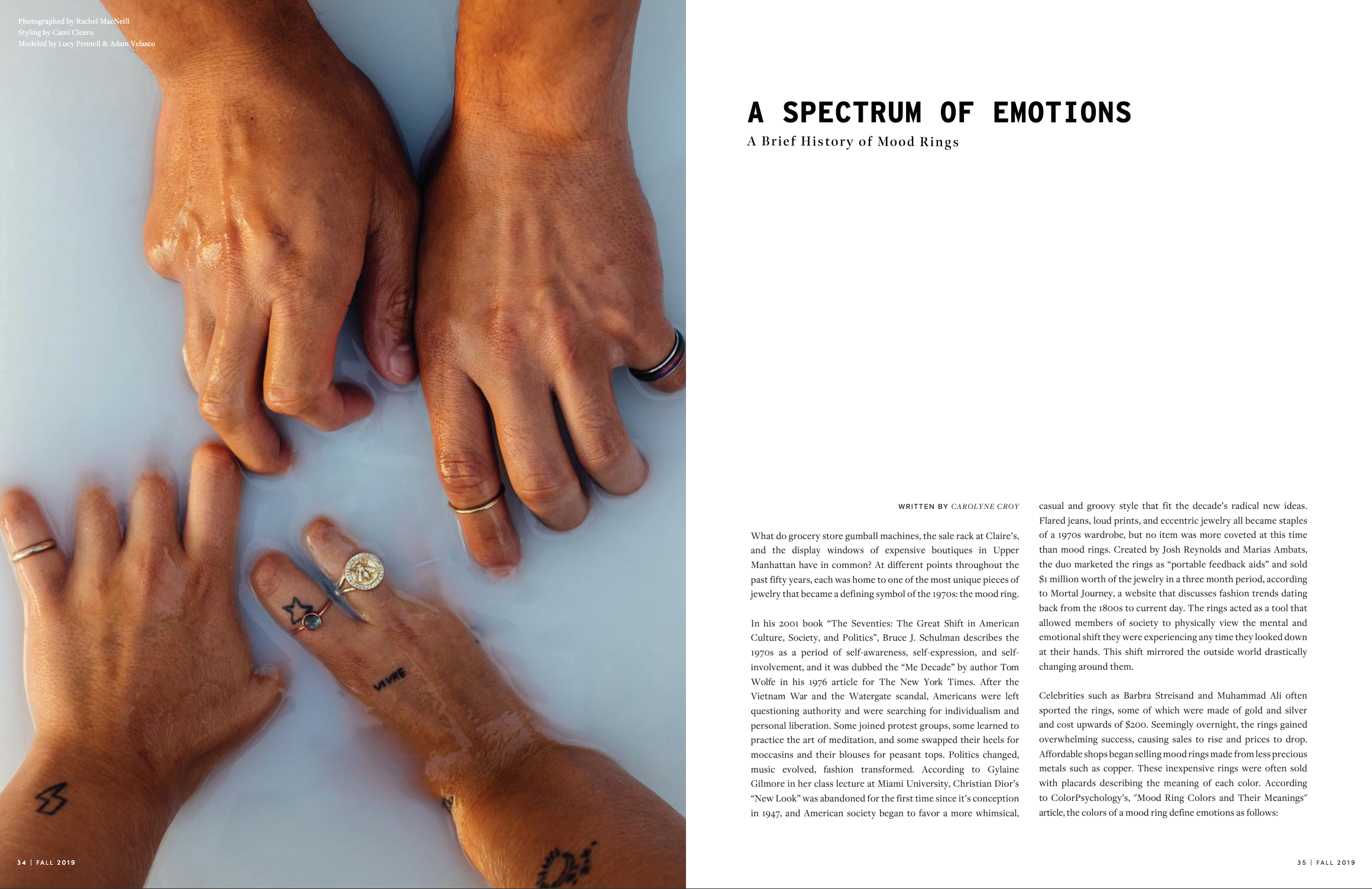
A Spectrum of Emotions – A Brief History of Mood Rings
What do grocery store gumball machines, the sale rack at Claire’s, and the display windows of expensive boutiques in Upper Manhattan have in common? At different points throughout the past fifty years, each was home to one of the most unique pieces of jewelry that became a defining symbol of the 1970s: the mood ring.
In his 2001 book “The Seventies: The Great Shift in American Culture, Society, and Politics”, Bruce J. Schulman describes the 1970s as a period of self-awareness, self-expression, and self-involvement, and it was dubbed the “Me Decade” by author Tom Wolfe in his 1976 article for The New York Times. After the Vietnam War and the Watergate scandal, Americans were left questioning authority and were searching for individualism and personal liberation. Some joined protest groups, some learned to practice the art of meditation, and some swapped their heels for moccasins and their blouses for peasant tops. Politics changed, music evolved, fashion transformed. According to Gylaine Gilmore in her class lecture at Miami University, Christian Dior’s “New Look” was abandoned for the first time since it’s conception in 1947, and American society began to favor a more whimsical, casual and groovy style that fit the decade’s radical new ideas. Flared jeans, loud prints, and eccentric jewelry all became staples of a 1970s wardrobe, but no item was more coveted at this time than mood rings. Created by Josh Reynolds and Marías Ambats, the duo marketed the rings as “portable feedback aids” and sold $1 million worth of the jewelry in a three month period, according to Mortal Journey, a website that discusses fashion trends dating back from the 1800s to current day. The rings acted as a tool that allowed members of society to physically view the mental and emotional shift they were experiencing any time they looked down at their hands. This shift mirrored the outside world drastically changing around them.
Celebrities such as Barbra Streisand and Muhammad Ali often sported the rings, some of which were made of gold and silver and cost upwards of $200. Seemingly overnight, the rings gained overwhelming success, causing sales to rise and prices to drop. Affordable shops began selling mood rings made from less precious metals such as copper. These inexpensive rings were often sold with placards describing the meaning of each color. According to ColorPsychology’s, “Mood Ring Colors and Their Meanings” article, the colors of a mood ring define emotions as follows:
BLACK: Anger, fear or apathy. The ring reverts to black when it exhausts its crystals, but wearers who see black while it’s still in use are often overworked or depressed.
YELLOW: Mixed or conflicted emotions. Yellow rings could suggest ambivalence, mild anxiety, or distraction.
ORANGE: Upset. The same basic feelings with yellow are amped up when the ring turns orange, and it often suggests nervousness, stress, or confusion.
LIGHT GREEN: A modest but unconcerning level of anxiety. Light-green could suggest mild jealousy or stress, or it could suggest a guarded or alert demeanor.
GREEN: Relaxed. Green is typically seen as the default color for most wearers, and it demonstrates stable emotions free of excessive negative or positive feelings.
BLUE: Upbeat. A blue ring is typical of someone who’s feeling in positive spirits but not overcome from an excessive tide of emotions. They could be optimistic and amiable but are still generally driven by rational thought.
DARK BLUE: Content. The dark-blue hue connotes that the inner sense of optimism has been fulfilled and translated into a degree of self-satisfaction. Wearers with dark blue rings are happy with their state of affairs and more prone to welcoming and generous behavior.
VIOLET: Romantic. Violet often appears in the presence of a crush, a lover, or an artistic passion. They may be moody, sensual, or mischievous, and that can lend a level of unpredictability to their decision making.
PINK: Infatuated. The level of heat given off when the ring shows pink denotes a person overcome by strong emotions.
As the trend gained traction and popularity, the validity surrounding mood rings came into question. Mood rings contain liquid crystals that are thermotropic, meaning they react to a heat source. When the crystals detect heat, their molecules twist and change their chemical structure, altering the crystal’s light reflection which determines what color the ring will project. A mood ring’s heat source is body temperature, and the normal body temperature of a human is 98.6 degrees Fahrenheit. Stress, anxiety, sadness and similar emotions cause blood to be pulled toward the vital organs and away from the extremities, such as fingers, causing the ring to detect a loss of heat which produces darker colors.
Miami University junior Jenn Soos touches on her own experience with mood rings: “I bought a mood ring as a friendship thing with a girl I met on a trip abroad.” Soos adds that the accuracy of the ring wasn’t always consistent. “Sometimes it can be very delayed or inaccurate, but sometimes it gets it right on the head!” The validity of mood rings has been in question since they came into popularity in the 1970s, but despite these questions surrounding their authenticity, the rings remained prominent in the fashion market. Soos says the inconsistency in the ring’s performance hasn’t deterred her from making another purchase, and she says she would consider buying another ring if the chance presented itself. Of course, there are other factors that affect a person’s body temperature like physical activity, or metabolizing food, according to an experiment done by Refinery 29. While mood rings are more accurate in detecting changes in temperature than defining one’s mood, the temperature changes act as indicators to show how one’s body reacts to different emotions.
Mood rings had a mild resurgence in the late 90s and early 2000s, but they were mainly marketed to children and sold at chain stores or offered as prizes in arcade games. But with the reappearance and overwhelming popularization of vintage and bohemian styles in the past few years, mood rings are back on the market. Trendy online stores like Urban Outfitters and Brandy Melville came out with several different styles of mood rings in 2017. Will this revival of vintage fashion encourage another mood ring craze?