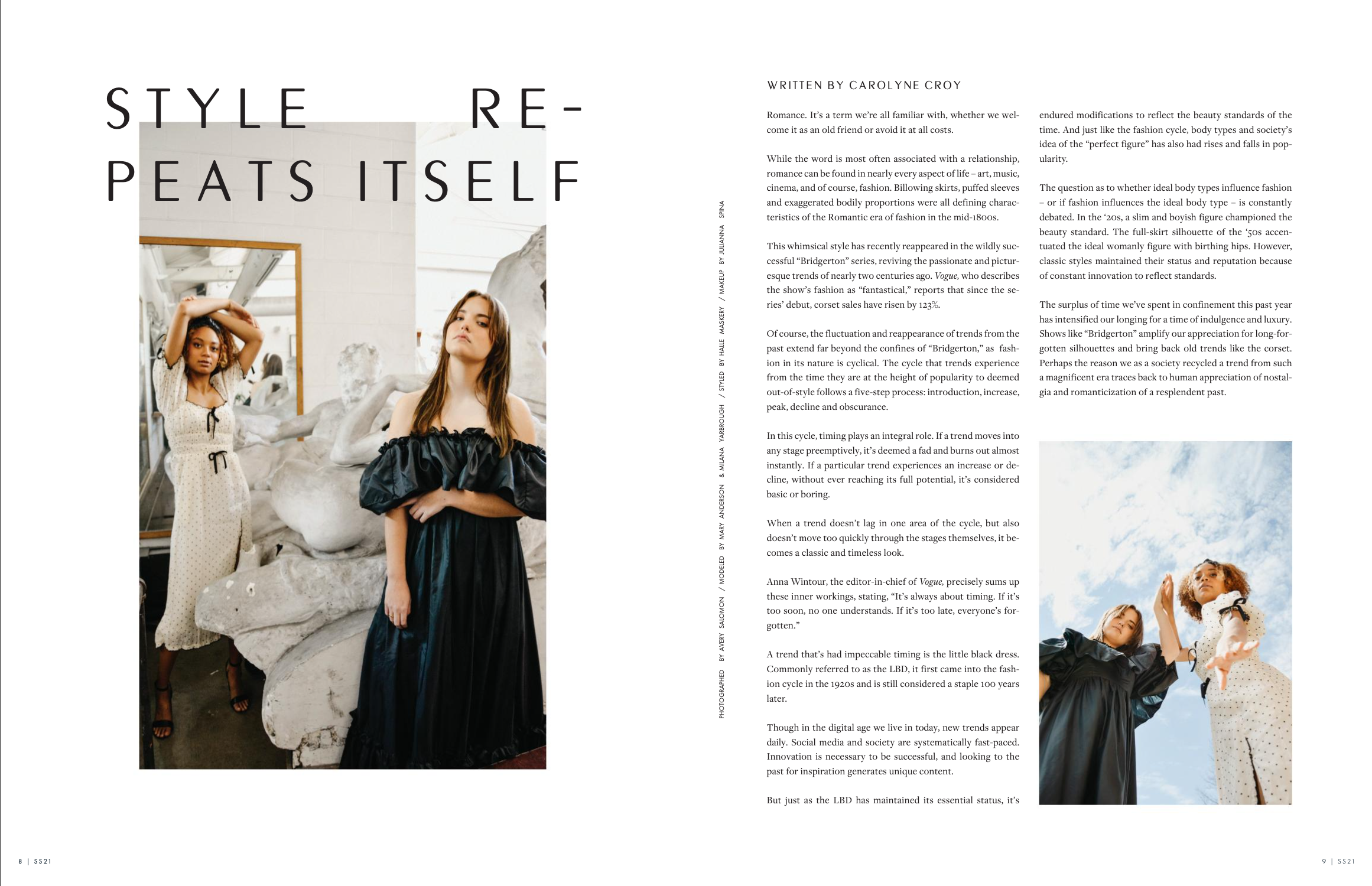
Style Repeats Itself
Romance. It’s a term we’re all familiar with, whether we welcome it as an old friend or avoid it at all costs.
While the word is most often associated with a relationship, romance can be found in nearly every aspect of life – art, music, cinema, and of course, fashion. Billowing skirts, puffed sleeves and exaggerated bodily proportions were all defining characteristics of the Romantic era of fashion in the mid-1800s.
This whimsical style has recently reappeared in the wildly successful “Bridgerton” series, reviving the passionate and picturesque trends of nearly two centuries ago. Vogue, who describes the show’s fashion as “fantastical,” reports that since the series’ debut, corset sales have risen by 123%.
Of course, the fluctuation and reappearance of trends from the past extend far beyond the confines of “Bridgerton,” as fashion in its nature is cyclical. The cycle that trends experience from the time they are at the height of popularity to deemed out-of-style follows a five-step process: introduction, increase, peak, decline and obscurance.
In this cycle, timing plays an integral role. If a trend moves into any stage preemptively, it’s deemed a fad and burns out almost instantly. If a particular trend experiences an increase or decline, without ever reaching its full potential, it’s considered basic or boring.
When a trend doesn’t lag in one area of the cycle, but also doesn’t move too quickly through the stages themselves, it becomes a classic and timeless look.
Anna Wintour, the editor-in-chief of Vogue, precisely sums up these inner workings, stating, “It’s always about timing. If it’s too soon, no one understands. If it’s too late, everyone’s forgotten.”
A trend that’s had impeccable timing is the little black dress. Commonly referred to as the LBD, it first came into the fashion cycle in the 1920s and is still considered a staple 100 years later.
Though in the digital age we live in today, new trends appear daily. Social media and society are systematically fast-paced. Innovation is necessary to be successful, and looking to the past for inspiration generates unique content.
But just as the LBD has maintained its essential status, it’s endured modifications to reflect the beauty standards of the time. And just like the fashion cycle, body types and society’s idea of the “perfect figure” has also had rises and falls in popularity.
The question as to whether ideal body types influence fashion – or if fashion influences the ideal body type – is constantly debated. In the ’20s, a slim and boyish figure championed the beauty standard. The full-skirt silhouette of the ’50s accentuated the ideal womanly figure with birthing hips. However, classic styles maintained their status and reputation because of constant innovation to reflect standards.
The surplus of time we’ve spent in confinement this past year has intensified our longing for a time of indulgence and luxury. Shows like “Bridgerton” amplify our appreciation for long-forgotten silhouettes and bring back old trends like the corset. Perhaps the reason we as a society recycled a trend from such a magnificent era traces back to human appreciation of nostalgia and romanticization of a resplendent past.